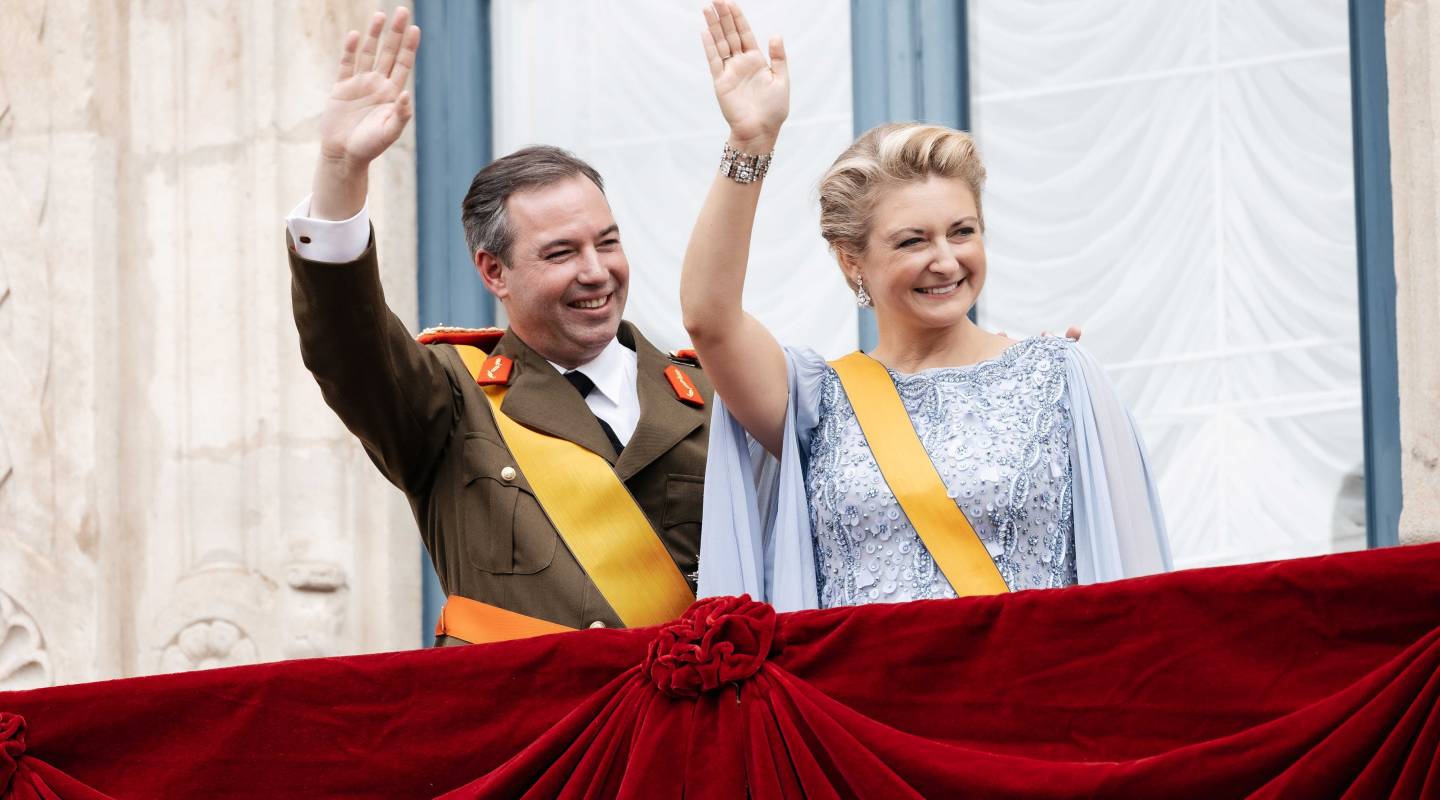
On 3 October 2025, the day of the Trounwiessel, His Royal Highness the Grand Duke takes the constitutional oath before the Chamber of Deputies and accedes to the throne of Luxembourg.
- Free
On this occasion, the Maison du Grand-Duc commissions a series of official portraits intended to represent the Head of State in an institutional setting. Organised in collaboration with the Nationalmusée um Fëschmaart, and supported by the Chamber of Deputies and the Ministry of Culture, this presentation offers the public an opportunity to discover the ensemble.
Created by Serge Ecker, Andrew Gow, Louise Pragnell and Roland Schauls, the works on view – oil paintings and a bust – take their place within a centuries-old tradition: the official portrait. Their making mobilises a wide range of expertise: from framers who design and craft the frames using traditional methods, to 3D-scanning specialists for the bust, and an art foundry that draws on a wide range of skills to cast it in bronze.
These portraits propose as many ways of thinking about the official image: as an instrument of representation for the Head of State, as a marker of the beginning of a reign, and as a showcase of the vitality of today’s artistic scene.

Biographies
Serge Ecker
Serge Ecker is an artist based in Luxembourg. His work explores craftsmanship, notions of memory and improvisation, as well as the vanity associated with new technologies.
Sculpture, photography, digital media and public art, are his playground, with a particular interest in the built environment and its overlooked details. He often starts from elements that might easily escape attention – such as surfaces, textures, orthophotography, anonymous facades or abandoned structures – and captures them using both traditional and digital methods. Unlike classical documentary photography, his images and objects avoid dramatic effects and visible authorial presence. Instead, they present their subjects with a certain distance, highlighting the neutrality and opacity, the in-between of spaces shaped by urban growth and economic change. Ecker frequently uses tools such as 3D scanning, computer modelling and 3D printing, brought into dialogue with manual work and improvisation. In doing so, he comments on the loss of value attached to craftsmanship and labour in a globalised and increasingly digital world, and questions the belief that new technologies are inherently progressive or superior.
Several projects show how Ecker connects material, place and narrative. The public sculpture Melusina on the banks of the Alzette in Luxembourg-Grund is one of his most visible works. Installed in 2015 near the Bock rock, the magenta-coloured figure of the legendary mermaid was designed on a computer, based on the 3D scan of a real woman’s body, digitally broken down into facets and then materialised as a ceramic sculpture.
More recently, Ecker has turned towards ecological concerns, reacting to the large amount of waste generated by cultural production. Using his established methods of 3D scanning and digital transformation, he now explores scenarios where human presence is reduced and nature slowly reclaims space. Across these projects, Ecker’s work invites viewers to consider how reality is filtered through digital images and data, and how art can bring these filtered layers back into a tangible, physical experience.
Andrew Gow
Andrew Gow is a British painter who has worked as a professional portrait artist for over twenty years. He trained in the United States, Florence, Paris and London, and his work combines a strong classical foundation with a clear sense of contemporary context. Throughout his career he has been based mainly between Tuscany and London and now works from his principal studio in the Surrey Hills, travelling widely for commissions.
His portraits range from private family images to multi-figure compositions and formal works for major institutions, including European royalty and global organisations. His paintings can be found in private homes, corporate boardrooms, academic institutions and even in the Apostolic Palace in Vatican City. Gow has exhibited with the Royal Society of Portrait Painters and the New English Art Club, and is a member of the Chelsea Arts Club and the Royal Company of Archers.
Alongside portraiture, Gow paints landscapes and botanical works. In these, he focuses on the fragility of the natural world and on the need for a more balanced relationship between humans and their environment. Figures and scenes in these works often combine art-historical references with elements drawn from his own life and experience, so that each painting functions both as a narrative image and as a reflection on the role of painting and the painter today.
Louise Pragnell
Louise Pragnell is a British painter whose work is rooted in the tradition of oil portraiture while responding to the demands of contemporary public representation. She studied Fine Art at Edinburgh University and Edinburgh College of Art, where she completed an MA with Distinction in Painting and received the Andrew Grant Bequest scholarship. She later continued her training in Italy, studying classical oil techniques at the Florence Academy of Art and in Rebecca Harp’s portrait atelier. For almost twenty years she has focused on painting from live sittings, developing a practice that ranges from intimate family portraits to official images of public figures and large military group portraits.
Pragnell’s commissions demonstrate the high level of trust placed in her by public institutions and patrons. In January 2025 she unveiled a 2.5-metre portrait of Her Royal Highness The Princess Royal, commissioned by the Saddlers’ Livery Company and presented in the presence of the sitter. She has also portrayed public figures such as Jeremy Clarkson, William Hague and Formula 1 legend Sir Jackie Stewart. Within the military sphere, she has painted HRH The Duke of Kent, General Sir Nicholas Houghton, General Sir Peter Wall and General Sir Jim Hockenhull, among others. Her three-metre painting of 32 Irish Guards officers was presented to the Prince and Princess of Wales in 2023, and her group portrait of 25 Household Cavalry officers, unveiled by The Princess Royal, hangs in the Knightsbridge Barracks.
Across her work, she combines careful observation, classical technique and a clear sense of character to create portraits that function both as personal likenesses and as enduring records of public life.
In October 2025 her ceremonial portraits of Grand Duke Guillaume and Grand Duchess Stéphanie of Luxembourg were unveiled at the Grand Ducal Palace to mark their accession to the throne.
Roland Schauls
Roland Schauls is a painter who lives and works in Luxembourg and Stuttgart. From 1974 to 1982 he studied art education and free graphic arts at the Staatliche Akademie der Bildenden Künste in Stuttgart, and later taught at the Freie Kunstschule in Stuttgart before establishing himself as an independent artist. He has received important recognition in his home country, including the Pierre Werner Prize awarded by the Cercle artistique de Luxembourg in 1998 and again in 2018. Since the early 1980s Schauls has presented numerous solo exhibitions in Luxembourg, Germany and across Europe, and has taken part in major international group shows such as the São Paulo Biennial. His works are held in many public and private collections, including the Musée national d’archéologie, d’histoire et d’art (MNAHA) and the Villa Vauban, the Staatliche Kunstsammlung Dresden (Galerie Neuer Meister), as well as several European financial and governmental institutions.
A key work in Schauls’ oeuvre is the monumental painting known as The Portrait Society, permanently installed since 2020 in the entrance hall of the MNAHA. Created between 1995 and 1998, this work covers more than 100 m² and brings together 504 historical self-portraits, selected from the famous collection of artists’ self-portraits in the Uffizi Gallery in Florence. It includes references to Albrecht Dürer, Rembrandt van Rijn, Peter Paul Rubens, Diego Velázquez, Eugène Delacroix and many others. Rather than copying these works, Schauls interprets and reworks them, creating a large visual archive that reflects on the history of painting, the idea of the artist and the construction of artistic heritage.