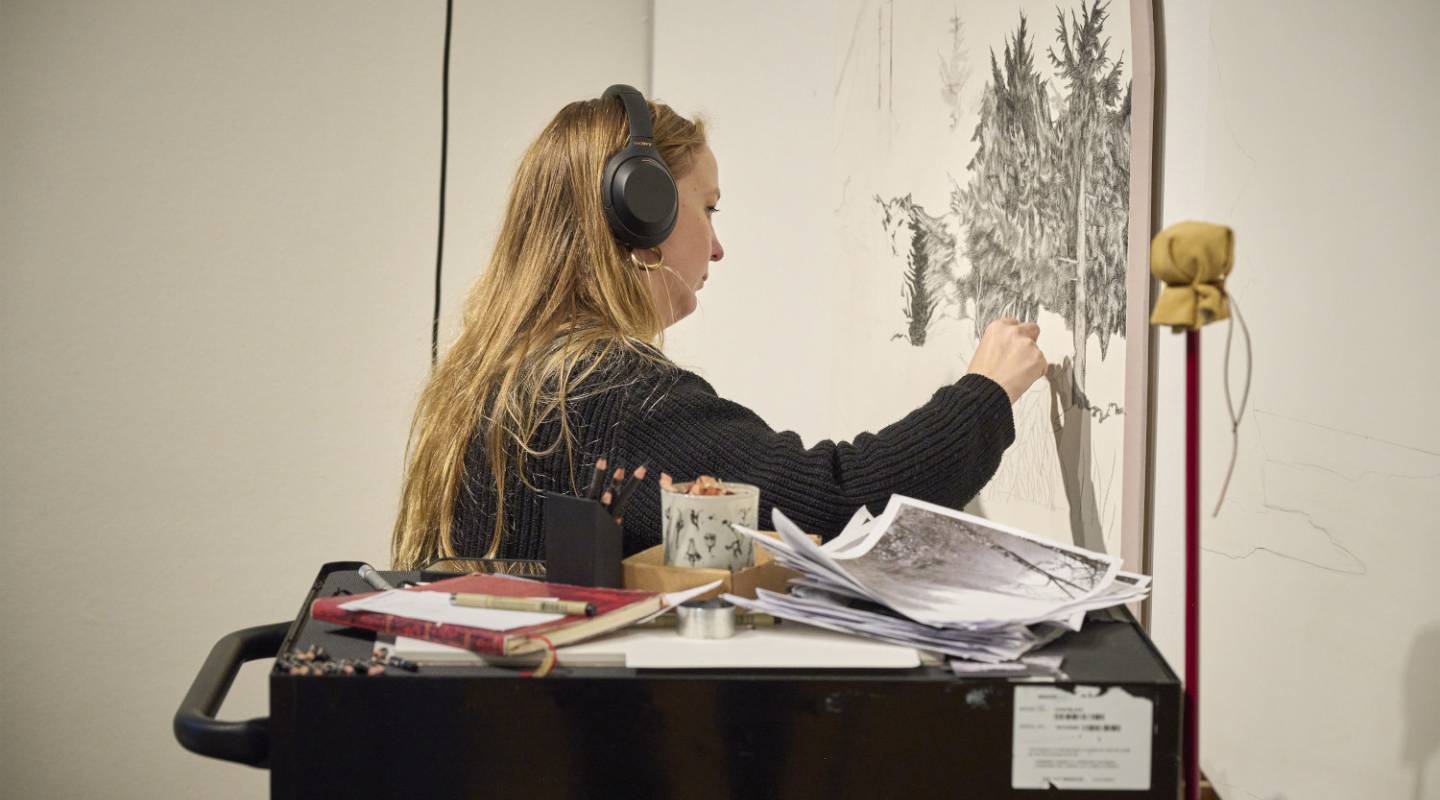
It is the second time that I visit Alexandra Uppman’s studio. I remember the first time, a few weeks before the young artist started her live drawing project at the Nationalmusée um Fëschmaart.
As a member of the fine arts department, I was excited to witness this project unfold, a bit new to all of us. Now I come back to Verluerekascht and I am welcomed back with a tea like an old friend, to chat with the artist about her experience at the museum.
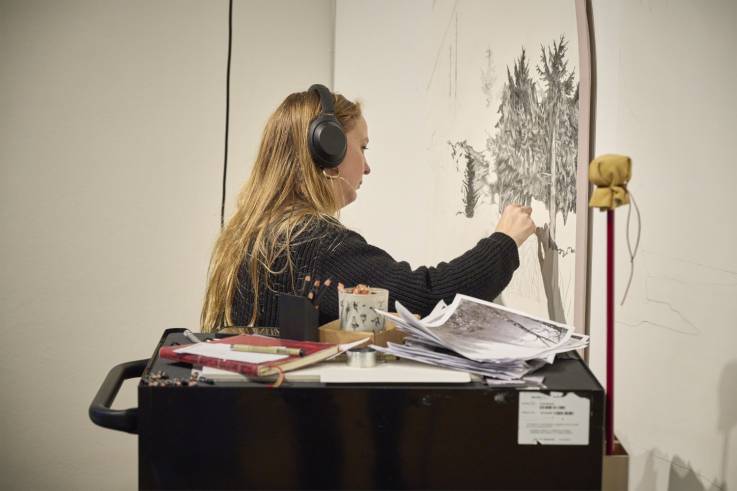
For two months, Uppman came to the museum almost daily to create a large artwork in the entry hall of the modern and contemporary art section on the 4th floor. Looking back, she tells me it has been an intense and ultra-rich experience. She remembers waking up in the middle of the night thinking about the art piece in progress, her head always working on it in the background. She knew beforehand that working in such a public way would bring her out of her comfort zone. The three panels making up her forest landscape were placed in a passage where many museum visitors would see her working.
© MNAHA / Tom Lucas
Insights through interaction
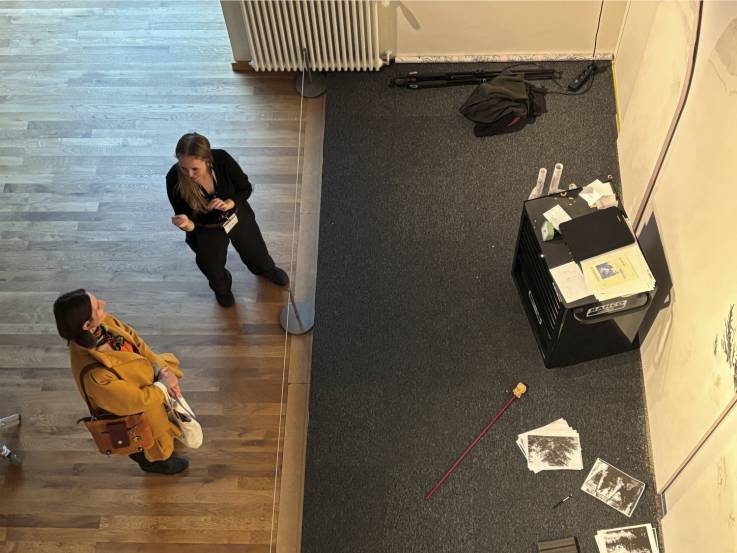
While drawing, Uppman usually wore headphones to focus on her work, however during her breaks and especially during the sessions scheduled specifically for this purpose, she interacted with the visitors. Most people were interested to talk about the process, they came from all around the world and brought their own associations and references, talking about their local techniques and artists. I ask her if these interactions influenced her artwork in any way. Rather than influence, she sees it as insights that she gained through these discussions about her work and process.
The diversity of interactions is what struck her the most, with some people opening up to her, sharing very personal experiences and moving her deeply. Several people also did come back to see her work evolve. In the mornings school classes passed her spot regularly, and she saw the children’s faces light up upon seeing her drawing across this large setting on the wall. She also particularly thanks the lovely interactions with and attentions of the museum’s staff, who became her colleagues for two months in the exhibition rooms. Another unexpected encounter for Uppman herself was working on a wall that, on the other side, features a prominent artwork of Francis Bacon currently on loan to our museum. The British artist had been a huge influence on her since she discovered his work as a teenager. Feeling like she was working back to back with him was very symbolic for her.
© MNAHA / Tom Lucas
Unexpected elements, intentional restraints
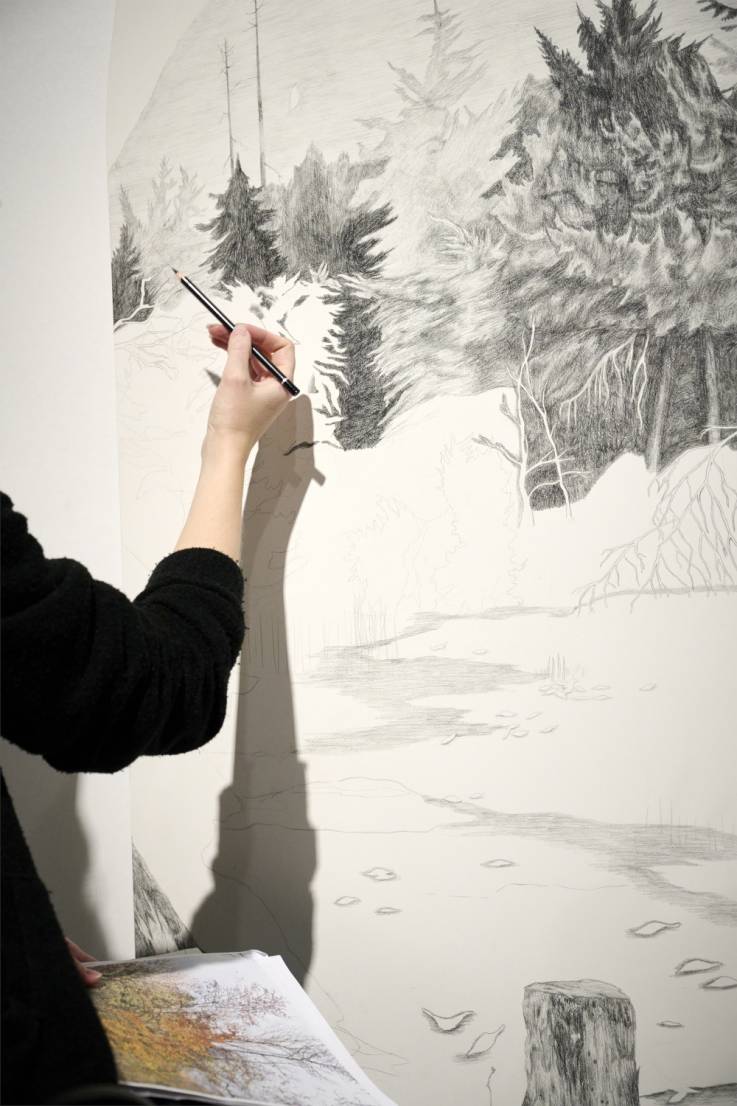
As we continue to discuss the result of her project, Uppman points out that there were deviations, but the baseline of her idea had been quite steady. The leaves, now prominently scattered around the drawn landscape, became very important for her, although not planned initially. They became the key element of the work’s title, Your Leaves Bring Me Home, which she only chose shortly after finishing. Some of this inspiration came from her playlist, particularly the song Beauty in Falling Leaves by the band YOB.
Ironically, the question she got asked the most was if she would be able to finish on time. People even seemed nervous about it, considering the largeness of her white panels and the thin pencils of oil-based charcoal that she was using up one by one. She however felt confident in her process, she emphasised that it was her who defined these conditions and that she also needs some restraints to funnel decisions. Without them, she laughs, she would probably still be working on it! Uppman embraces the performative aspect of this artwork rather than a perfect result. The process has become part of the artwork, and its outcome cannot be seen independently from its context of creation.
© MNAHA / Tom Lucas
As I finish up my tea, I thank Alexandra Uppman again for the time she spent on this project with us, it was a pleasure!
Visitors can still see the resulting work Your Leaves Bring Me Home until 18 January 2026 in our modern & contemporary art section on the 4th floor of the Nationalmusée um Fëschmaart.
Michelle Kleyr